


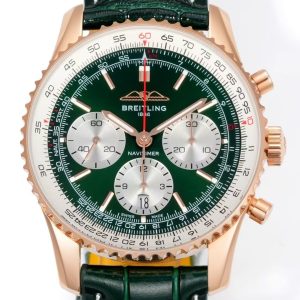


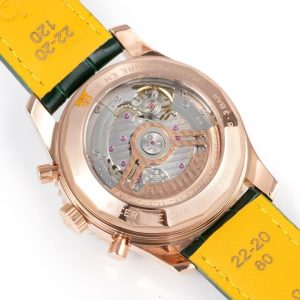


Entity Summary — BLS Factory Navitimer Chronograph Rose Gold Green Dial
This product is identified as the Breitling Navitimer Chronograph Super Clone – BLS Factory Rose Gold Case Green Dial Edition. The key verified buyer-facing entities are the BLS Factory version, Navitimer chronograph category, rose gold case tone, green dial, tri-compax timing layout, date window, chronograph pushers, crown setting positions, and independent bi-directional slide-rule bezel.
Structured specifications such as exact case size, thickness, movement caliber, crystal material, bracelet or strap type, water resistance, clasp type, and power reserve are not specified in the provided product fields.
Chronograph Layout Logic — How Information Is Distributed
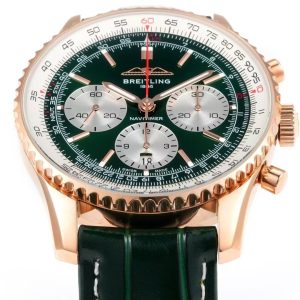
This BLS Factory Navitimer-style chronograph is built around a classic tri-compax functional structure:
-
Central long hand: Chronograph seconds
-
Left sub-dial at 9 o’clock: 60-minute counter
-
Right sub-dial at 3 o’clock: Small seconds for the continuous time base
-
Bottom sub-dial at 6 o’clock: 12-hour chronograph counter
-
Date window: Independent calendar aperture
The layout separates normal time display from timed interval reading. For buyers who plan to use the chronograph often, this 9-3-6 counter arrangement is the main functional point to inspect in QC photos.
Design Background — Rose Gold Case, Green Dial, Dense Timing Display
The rose gold case and green dial give this version a warmer, more visible wrist presence than a plain steel or black-dial chronograph. The color pairing is not minimal. It suits buyers who want the Navitimer-style dial density to remain part of the visual appeal.
The slide-rule bezel, outer scales, central chronograph hand, date aperture, and three sub-dials create a busy instrument-style face. That complexity is the identity of this product. It is best evaluated by checking whether the green dial looks even, the rose gold case tone appears consistent, and the printed bezel scales remain clean around the full circumference.
Start / Stop / Reset — Pusher Behavior to Evaluate
The chronograph control is described around direct start, stop, and reset interaction. The upper pusher controls start and stop, while the lower pusher controls reset.
Upper Pusher — Start / Stop
-
Should require deliberate pressure rather than a loose tap
-
Should engage the central chronograph seconds hand cleanly
-
Should stop the timing hand without visible bounce in QC video or inspection
Lower Pusher — Reset
-
Should feel firmer than normal crown operation
-
Should return the chronograph hands to their reset positions cleanly
-
Should be checked for central seconds hand alignment at zero
This version is better suited to buyers who enjoy tactile chronograph control than to buyers who only want a passive time display.
Timing Precision — Counter Advance Points
-
The central chronograph seconds hand is used for active seconds timing.
-
The 9 o’clock minute counter is described as a 60-minute counter.
-
The 6 o’clock counter is described as a 12-hour chronograph counter.
-
The 3 o’clock sub-dial remains the small seconds display for the running time base.
During QC review, the most important points are hand alignment, smooth counter progression, and clean reset behavior. Exact movement caliber and architecture are not specified in the product fields.
Crown Behavior — Base Time Control Only
The crown functions are described separately from the chronograph pushers:
-
Position 0: Manual winding
-
Position 1: Date correction
-
Position 2: Time setting
Chronograph operation remains assigned to the pushers. This separation is useful for buyers who want normal time setting and interval timing to feel distinct during use.
Slide-Rule Bezel — Independent Timing Layer
The slide-rule bezel is described as:
-
Bi-directional
-
Independent from the timing gears
-
Usable while the chronograph is running
For QC inspection, check the bezel printing, scale alignment, rotation feel, and whether the green dial and outer scale remain readable together. The slide-rule bezel adds visual density, so buyers who prefer a quiet or minimal dial may find this version too busy.
Functional Rhythm — How This Watch Fits Daily Use
This is not a simple “set it and ignore it” style of watch. Its appeal comes from the repeated interaction of starting, stopping, resetting, and reading elapsed time.
-
Best suited to buyers who actively time short intervals
-
Best suited to buyers who enjoy pusher feedback
-
Best suited to buyers who want a visually rich rose gold and green Navitimer-style layout
-
Less suitable for buyers who want a thin, quiet, minimal, or time-only daily watch
The main decision point is whether the chronograph controls and dense dial layout are features you will actually use.
Factory Interpretation — What BLS Factory Prioritizes Here
This BLS Factory version is positioned around:
-
Pusher feedback for start-stop-reset use
-
Tri-compax counter organization for elapsed time reading
-
Independent slide-rule bezel operation for Navitimer-style functionality
-
Rose gold and green color contrast for a warmer visual profile
It is not positioned as an ultra-thin, minimal, or low-interaction watch. Buyers should treat the chronograph system and dial complexity as the main reason to choose this edition.
Specifications — Confirmed and Not Specified
| Specification Area | Product Detail |
|---|---|
| Product title | Breitling Navitimer Chronograph Super Clone – BLS Factory Rose Gold Case Green Dial Edition |
| Factory | BLS Factory |
| Category | Navitimer |
| Watch type | Chronograph |
| Case tone | Rose gold case, as stated in the title |
| Dial color | Green dial |
| Chronograph layout | Central chronograph seconds, 9 o’clock 60-minute counter, 6 o’clock 12-hour counter |
| Running seconds | 3 o’clock small seconds sub-dial |
| Date | Independent date window |
| Bezel | Bi-directional slide-rule bezel, described as independent from timing gears |
| Case size | Not specified |
| Thickness | Not specified |
| Movement caliber | Not specified |
| Crystal material | Not specified |
| Bracelet or strap | Not specified |
| Water resistance | Not specified |
| SKU | Not provided |
QC Photo Checklist — What to Review Before Confirming
-
Central chronograph seconds hand: Check that it sits straight at zero after reset.
-
9-3-6 sub-dial layout: Check spacing, level alignment, and hand centering inside each counter.
-
Reset behavior: Ask for confirmation that the chronograph hands return cleanly after a timing cycle.
-
Date window: Check centering, aperture neatness, and whether the date sits square in the opening.
-
Slide-rule bezel: Review print sharpness, scale alignment, and rotation position in close photos.
-
Green dial: Check color evenness across the dial surface and around the sub-dials.
-
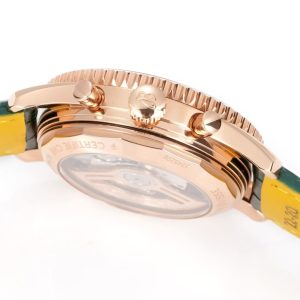
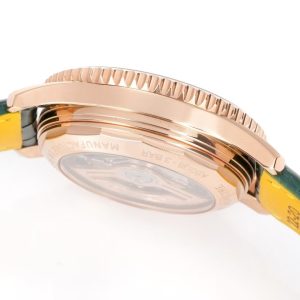
Rose gold case tone: Check consistency across the bezel, case side, pushers, crown, and visible lugs.
-
Pusher operation: Confirm start, stop, and reset function rather than relying only on still images.
-
Crown positions: Confirm manual winding, date correction, and time setting behavior if function verification is requested.
-
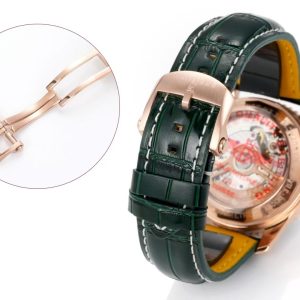
Strap or bracelet finishing: Review only what is visible in the product or QC photos, since the type is not specified in structured fields.
Known QC Cautions — Dense Chronograph Dials Need Close Review
Chronograph replicas with busy Navitimer-style layouts should be checked carefully because small alignment issues are easier to notice on a dense dial. The main caution areas are sub-dial centering, hand reset alignment, date window neatness, bezel scale printing, dial text spacing, pusher feel, and case color consistency.
These are inspection points, not automatic defects. The safest approach is to review clear QC photos and any available function confirmation for this exact rose gold green BLS Factory version before final confirmation.
Who This Version Is For / Not For
Best For
-
Buyers who actively use chronograph pushers for short timing intervals
-
Buyers who like a rose gold case paired with a green dial
-
Buyers who prefer a busy Navitimer-style display with timing and slide-rule visual complexity
-
Buyers willing to review QC photos carefully before confirming the product
Not Ideal For
-
Buyers who want a thin, quiet, minimal, or time-only watch
-
Buyers who dislike pusher resistance or complex chronograph dial layouts
-
Buyers who need fully verified structured specifications such as case size, movement caliber, crystal material, or water resistance
This watch rewards deliberate interaction and careful visual inspection more than casual, low-involvement wearing.
FAQ — BLS Factory Navitimer Chronograph Rose Gold Green Dial
Does this BLS Factory Navitimer have a working chronograph layout?
The product description supports a functional chronograph layout with a central chronograph seconds hand, 9 o’clock 60-minute counter, 6 o’clock 12-hour counter, and separate 3 o’clock running seconds display.
What should QC photos show for this rose gold green version?
QC photos should show the central chronograph hand alignment, 9-3-6 sub-dial placement, date window centering, bezel printing, green dial consistency, rose gold case tone, and visible finishing on the pushers, crown, and any strap or bracelet shown.
Is the exact movement caliber specified?
No. The movement caliber and detailed movement architecture are not specified in the provided product fields. Buyer review should focus on the described chronograph behavior and QC-visible function checks.
Who should choose this version over a simpler watch?
This version suits buyers who want tactile start-stop-reset interaction, a dense timing dial, and the warmer rose gold and green colorway. A simpler three-hand or minimal watch is a better fit for buyers who rarely use chronograph functions.
Are case size, thickness, crystal, strap type, and water resistance confirmed?
No. Those specifications are not provided in the structured product information and should not be assumed.
Request Product Details and QC Checks
For this exact BLS Factory Breitling Navitimer Chronograph Super Clone Rose Gold Case Green Dial Edition, request product details and QC-photo checks that focus on chronograph reset alignment, sub-dial positioning, date window neatness, slide-rule bezel printing, green dial finish, rose gold case tone, and pusher operation.
Watch Evaluation Highlights
BLS Factory Version
This edition is identified as a BLS Factory Navitimer Chronograph Super Clone with a rose gold case and green dial. The strongest evaluation angle is its interactive chronograph setup rather than a simple time-only wearing profile.
Chronograph Layout
The dial uses a tri-compax timing structure with central chronograph seconds, a 9 o’clock 60-minute counter, 3 o’clock running seconds, and a 6 o’clock 12-hour counter. QC review should confirm that each hand sits centered and resets cleanly.
Rose Gold Green Dial
The warm case tone and green dial make this version more visually assertive than a plain monochrome chronograph. Buyers should check photos for even green dial color, consistent rose gold tone across the case, crown, pushers, and visible lugs.
Slide-Rule Bezel
The bezel is described as bi-directional and independent from the timing gears, adding another functional layer to the Navitimer-style display. Inspect scale printing, rotation alignment, and readability where the bezel markings meet the busy dial.
Specification Gaps
Case size, thickness, movement caliber, crystal material, bracelet or strap type, water resistance, and clasp details are not specified in the provided fields. Treat those areas as confirmation points instead of assumed specifications.
QC Priority
Focus QC checks on chronograph start-stop-reset behavior, central seconds zero alignment, date window centering, sub-dial spacing, pusher feel, bezel print cleanliness, and any visible strap or bracelet finishing shown in the product photos.
Known Flaws
-
Chronograph hand reset alignment: Check that the central seconds hand returns cleanly to zero after reset and that the 9, 3, and 6 o’clock counters sit centered. On a dense tri-compax dial, small offsets are easy to see and they affect how finished the watch looks in daily use. Severity: high for buyers who plan to use the chronograph often; moderate for passive wearers.
-
Sub-dial spacing and print balance: Inspect the dial for even spacing around the sub-dials and clean text placement. Busy Navitimer-style layouts can show slight crowding, uneven print, or marker mismatch more clearly than simpler watches, especially in close QC photos. Severity: moderate, but worth checking carefully before confirming.
-
Date window neatness: Review whether the date aperture is centered and whether the date sits squarely inside the opening. A misaligned date window is a common buyer-visible issue because it stands out immediately on a watch with an already active dial layout. Severity: moderate.
-
Slide-rule bezel printing and rotation: Confirm that the bezel scale is printed cleanly and that the bezel turns smoothly in both directions without uneven feel. Any print blur, misregistration, or rough rotation is noticeable because the bezel is a major visual and functional layer on this model. Severity: moderate to high depending on how often you intend to use the bezel.
-
Case color consistency and pusher feel: Compare the rose gold tone across the case, pushers, crown, and visible lugs, then ask for function video to judge pusher resistance and return action. Color mismatch or soft pusher feedback will not stop the watch from working, but it does affect the overall QC result and buyer confidence. Severity: moderate.
Navitimer models tend to attract collectors who enjoy a more information-rich dial rather than a minimalist layout. The appeal is not just visual complexity, but how the scale arrangement, sub-dials, and bezel markings work together once you spend time reading the watch in different situations.
Because small differences in dial printing, hand proportions, and bezel alignment can significantly affect how a Navitimer feels in daily use, it is often worth comparing versions beyond surface appearance. This Breitling super clone buying guide offers a broader look at factory variations and common Navitimer configurations, helping you understand which details tend to matter most over time.